
A natural
anti-inflammatory
supplement

What is Antinol® (PCSO-524®)?

Antinol® is a natural anti-inflammatory supplement for the veterinary market containing a patented lipid extract isolated from the New Zealand green-lipped mussel, Perna canaliculus, called PCSO-524®.

Antinol® contains PCSO-524® in combination with olive oil, and a small amount of vitamin E added as an antioxidant.

The patented process involves extracting the oil from green lipped mussels which are first stabilised and freeze-dried.

Early in vitro and in vivo research indicated significant anti-inflammatory properties. However, this research also revealed inconsistencies in the results due to the poor stabilisation of the lipids. Subsequent research and further development culminated in the stabilised patented lipid extract PCSO-524® found in Antinol®.

PCSO-524® contains a unique combination of free fatty acids, sterol esters, polar lipids, and carotenoids, and has been shown to be a 5-lipoxygenase (LOX) 1 and cyclooxygenase 2 (COX-2) modulator 2 providing a potent anti-inflammatory effect. 3-6 The majority of the research using PCSO-524® has been in support of its antiinflammatory activity, particularly in arthritis, where it has been compared to non-steroidal anti-inflammatory drugs (NSAIDs) in several animal clinical trials.

The manufacture and extraction process of PCSO-524® has been developed over many years and is covered by several international patents.

The extraction is undertaken using supercritical fluid extraction (SFE) technology which uses liquid carbon dioxide (CO2) as a solvent. CO2 is an ideal solvent as it becomes liquid under increased pressure and after extracting the oil the pressure is raised, and the CO2 turns back into a gas leaving the extract intact.

PCSO-524® is produced in Nelson, New Zealand where the green-lipped mussels are farmed in pristine waters.

The stabilisation process and freeze drying of the mussels is conducted by Pharmalink International (PIL) shareholder and manufacturing partner MacLab and the extraction is completed in a state of the art facility owned by Pharmalink Extracts Limited. The patented PCSO-524® extract is sold in more than 40 countries around the world in soft-gel capsules, blister packed in aluminium foil, which are encapsulated and packaged by a number of GMP-approved facilities around the globe.

Unique features of Antinol® / Point of difference

The unique lipid extract within Antinol® is different in structure compared with other marine oils (i.e. fish oils) in the chemical bonding of the omega fatty acids and incorporates a wide diversity of lipid classes.

91 individual fatty

There are over 91 individual fatty acids reported within the lipid extract with only 16 at concentrations greater than 1% of the total fatty acids 7

Anti-inflammatory compound

Specific fractionation studies have shown a range of anti-inflammatory compounds found within the PCSO-524® matrix 8, 9

The Primary Component

The primary anti-inflammatory component of the lipid mix has not been identified but has been determined to be more complex than just the DHA / EPA component

Integrity

The anti-inflammatory action of the whole extract (PCSO-524®) is more effective than the sum of its parts

The importance of a stabilised extract

The patented extraction process has been refined over a number of years and produces an extract with consistent anti-inflammatory results due to the stable, consistent nature of the product. The early research informed us that a non-stabilised mussel powder could not consistently produce positive results, crude extracts were vulnerable to chemical change over time providing variable or unpredictable results.

Effectiveness

Most green-lipped mussel (GLM) extracts on the market are not stabilised extracts and therefore may be vulnerable to change over time. No other product has the stabilisation process used by PIL to manufacture Antinol®. Comparison of different mussel extracts for their anti-inflammatory activity reveal a wide variability in effectiveness, showing the stabilised lipid extract to be far superior 10

Compared to Non-stabilised GLM Extract

Comparison of similar clinical trials using a non-stabilised mussel extract 11 to Antinol® 12 for treatment of osteoarthritis in dogs have shown stronger outcomes for Antinol®

Compared to Counter Treatment

Comparison of PCSO-524® to other available over the counter treatments for osteoarthritis in a rat trial, place it in the top two products of a group of 27, with the other top product being the stabilised GLM powder from which Antinol® is made 10

Compared to Fish Oil

A clinical trial comparing Antinol® to fish oil for treatment of osteoarthritis in dogs has shown considerable clinical benefit for Antinol® over fish oil. In conjunction with this, the results showed a significantly decreased biomarker of cartilage breakdown in the Antinol® group, which was increased in the fish oil group 13

Compared to other Nutraceuticals

Clinical trials have also demonstrated the superiority of Antinol® to other nutraceuticals commonly used for arthritis or joint disease in dogs. These include glucosamine, chondroitin, and avocado soy-bean unsaponifiables 12, 14

Anti-inflammatory Activity

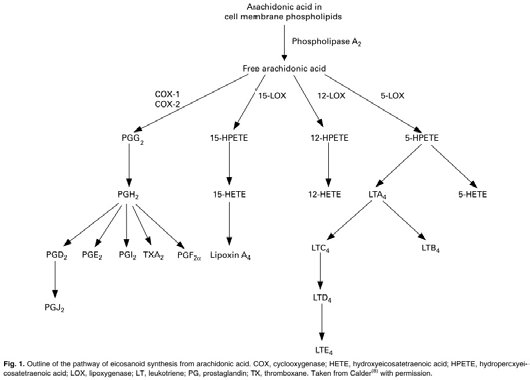
There are two major inflammation pathways relevant to pain in osteoarthritis (OA). These are the cyclooxygenase pathways (COX-1 and COX-2) and the lipoxygenase pathway, which can be separated into 3-arms (15-LOX, 12-LOX and 5-LOX) of which the 5-LOX pathway is the best studied for OA.

COX and LOX pathways are inflammatory cascades that are initiated in ordinary cells from the lipid content that makes up the cellular membranes. Initiation and control of the inflammatory process are complex and governed by an array of biomolecular mechanisms. One important pro-inflammatory mechanism is associated closely with the cell-membrane-bound fatty acid arachidonic acid, which becomes converted into other compounds in the body that are potent pro-inflammatory substances. These pathways are shown in Figure 1.

The composition of the cellular fatty acids within cells is an area of particular interest when looking at the effects of dietary or supplemental fatty acids in the body (i.e. PCSO-524®). The composition can directly influence inflammatory processes in the body. In fact, research is now suggesting that fatty acids within the diet can alter OA risk and severity 15.

working in conjunction with NSAIDs, or to replace NSAID use

Non-steroidal anti-inflammatory drugs (NSAIDs) are among the most widely used drugs for arthritis conditions in humans and animals.

One of their main mechanisms of action is inhibition of the COX enzyme (shown with its link to the inflammatory mediators produced from arachidonic acid in Figure 1), which in turn, inhibits the production of prostaglandins, especially PGE2, one of the key inflammatory mediators known to cause inflammation and therefore pain, which is strongly implicated in OA 17.